The European rail system enables safe, accessible, and clean mobility, economic opportunity, and social cohesion. And it plays a significant role in Europe’s peace and defence strategy, which receives increased attention and investments since Russia attacked Ukraine and since the United States has called its unwavering role as security guarantor into question. A harmonised, high-capacity, electrified rail transport system can contribute to human and state security by deterring further aggression, enabling swift movement of personnel and equipment in the event of a crisis, and by offering climate-neutral civilian transport in peacetime. However, in its current overstrained and fragmented status, it cannot realise its potential for climate, transport and security: Currently, it can take several weeks to move personnel and equipment across Europe and the share of rail in freight traffic is declining despite political goals to shift to rail.
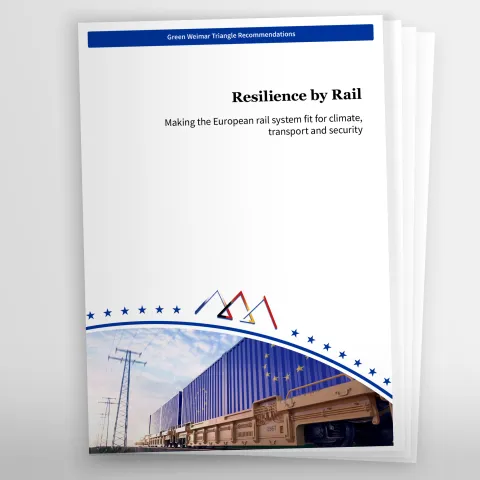
Based on research and a high-level workshop with rail, climate, and military experts from Poland, Germany, and France, Germanwatch summarizes key constraints and policy recommendations to enable benefits of the European rail system for climate, transport and security. The workshop included high-ranking experts from the Green Weimar Triangle countries spanning from the Atlantic to the Baltic states and from institutions such as NATOs Joint Support and Enabling Command, PESCO, the United States Army Europe, Ministries of Defence, the Warsaw Security Forum, the national rail and infrastructure companies PKP, DB, and SNCF, Transport & Environment, the Community of European Railway and Infrastructure Companies (CER), and the European Rail Freight Association (ERFA). The paper also contains considerations on the interface of a European peace and defence approach with human security, peacetime and civilian benefits at its core.