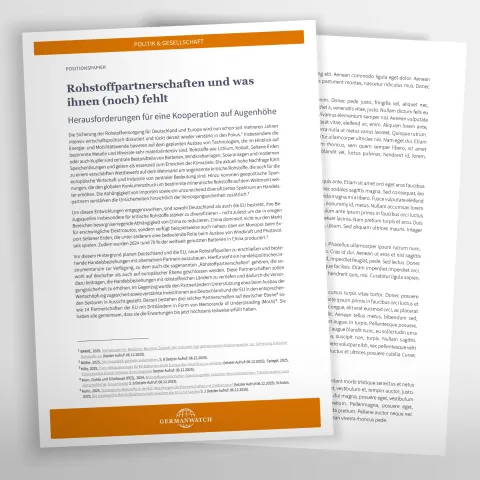
Raw material partnerships are a means of securing the supply of critical minerals and metals, such as lithium, cobalt, rare earths and copper, for Germany and Europe. Increased investment and support in partner countries is expected to promote the expansion of the raw materials sector and the development of the necessary local infrastructure.
However, after around a decade, it has become clear that the results of these partnerships have fallen short of expectations so far. Given the growing demand resulting from the energy and mobility transition, geopolitical tensions and ongoing dependencies — particularly on China — there is increasing pressure to access new sources of supply. At the same time, there is a risk of imbalance: if economic interests become too closely linked to development cooperation instruments, social and environmental objectives may take a back seat.
This policy paper analyses the shortcomings of existing partnerships and makes recommendations for enabling genuine cooperation ‘on equal terms’.