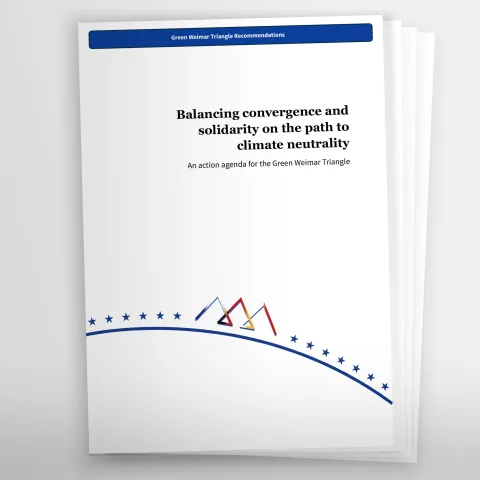
In the coming months, a series of interconnected EU‑level negotiations will shape the future of European climate and environmental policy. Our new Germanwatch briefing explores how Germany, Poland, and France, within the framework of the Green Weimar Triangle, can help design a balanced European climate policy mix that combines climate ambition, competitiveness, and social fairness.
The briefing focuses on three key areas:
- A post‑2030 climate framework: Balancing the EU-wide Emissions Trading System (ETS) with specific national targets is vital to ensure fairness and accountability.
- Future‑proofing Europe’s competitiveness: The Weimar countries can drive innovation, circular economy approaches, and a fair industrial transition.
- Paving the way globally: Joint action on decarbonisation and climate diplomacy can reinforce Europe’s global leadership.
The briefing concludes not only that the diversity of approaches within the Green Weimar Triangle reflects Europe’s strength but that structured, permanent cooperation can help balance convergence and solidarity across the Union.
Germanwatch publishes this paper ahead of the upcoming meeting of the environment and climate ministries of Germany, Poland, and France on 29 September 2026. After twelve years, the trilateral format is gaining momentum again, offering new opportunities for joint climate action and a just transition in Europe.