A decade after the Paris Agreement, the geopolitical dynamics of climate action have fundamentally shifted. While China now dominates global clean technology markets, the United States under Trump has turned away from climate multilateralism. At the same time, the US attack on Iran has unleashed a global energy crisis that could, paradoxically, accelerate the global transition toward renewables. Caught between its dependence on fossil fuel imports from the US and its technological reliance on China, the EU finds itself at a strategic turning point.
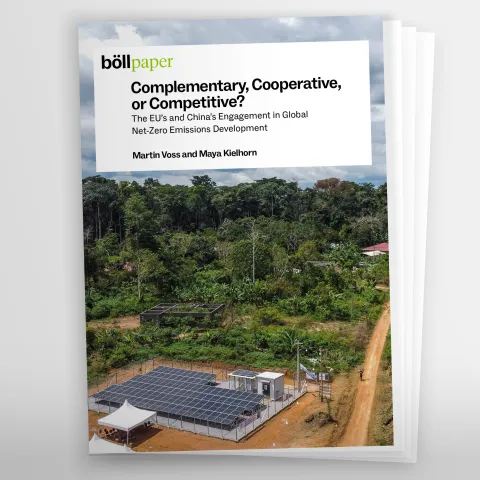
This policy paper explores how the EU and China engage across the Global South in support of net-zero development, and what this implies for European strategy. Case studies from Kenya, South Africa, the Philippines, Namibia, Morocco, and the DRC demonstrate clearly that the key question is not whether the EU engages with China, but how – whether competitively, complementarily, or cooperatively, depending on the context. Rather than attempting to match China's manufacturing scale, Europe should leverage its specific advantages – development financing, governance expertise, and regulatory power – more strategically and consistently than before.
The study was commissioned by the Heinrich Böll Foundation.