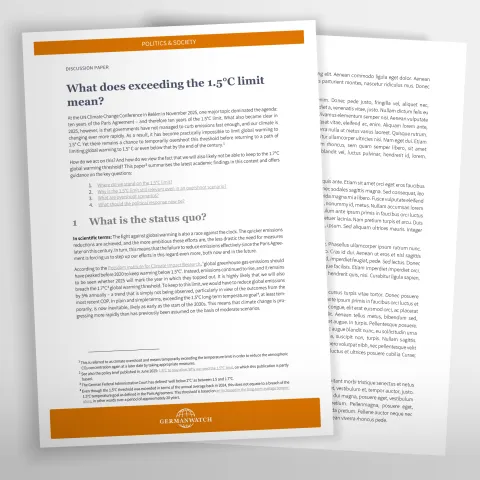
A temporary exceedance of the 1.5°C long-term temperature goal of the Paris Agreement is now considered almost unavoidable—potentially as early as the beginning of the 2030s. This indicates that climate change is progressing faster than previously assumed. In this context, so-called overshoot approaches are gaining importance, referring to a temporary exceedance of the 1.5°C threshold followed by a return to the target through the removal of CO₂ from the atmosphere.
This paper provides guidance on key questions: Where do we stand on th 1.5°C limit? Why is the 1.5°C limit still relevant even in an overshoot scenario? What are overshoot scenarios? What should the political response noe be? It shows that exceeding the 1.5°C limit further increases the urgency for action: emissions reductions must be significantly strengthened, transformative adaptation measures must be implemented, and adequate financing must be ensured. Crucially, the measures taken today will have a decisive impact on future developments—conversely, insufficient emissions reductions will lead to more severe climate impacts as well as higher costs for adaptation and mitigation measures.