At the COP28 climate conference in Dubai, countries agreed on a historic ‘beginning of the end’ of fossil fuels. Parties called on governments to contribute to
‘Transitioning away from fossil fuels in energy systems, in a just, orderly and equitable manner, accelerating action in this critical decade, so as to achieve net zero by 2050 in keeping with the science’ (UNFCCC, 2023a, art. 28d)
This is a huge endeavour. In terms of finance, by 2050, at least USD 26 trillion must be redirected from coal- and oil-based technologies towards transition solutions to keep climate goals within reach.
At COP30, no joint UNFCCC decision was reached to set out specific steps; instead, individual coalitions of the willing formed to drive the agenda forward. More than 80 countries supported the Belem Declaration on the Transition Away From Fossil Fuels initiated by Colombia, while Brazil started a process for elaborating a ‘COP30 Presidency Roadmap for Transitioning Away from Fossil Fuels in a Just, Orderly and Equitable Manner’ (paragraph 28.d/GST1).
The next step on the path to a global transition away from fossil fuels (TAFF) is the Santa Marta Conference, officially titled the ‘First Conference on Transitioning Away from Fossil Fuels’, scheduled for 24–29 April 2026, in Santa Marta, Colombia.
The Santa Marta Conference
Co-hosted by the governments of Colombia and the Netherlands, the conference aims to bring together governments, experts, civil society, Indigenous communities, and industry representatives to identify practical and equitable pathways for reducing global dependence on fossil fuels. Its three thematic pillars are: Overcoming Economic Dependence, Transforming Supply and Demand, and Advancing International Cooperation and Climate Diplomacy. Rather than serving as a formal negotiation forum, it is designed as an implementation-oriented platform with a strong emphasis on fostering international cooperation and developing actionable strategies. It ties in with and complements existing processes at the UN level such as the TAFF roadmap which was initiated at COP30 in Belém and is being developed under the leadership of the Brazilian COP30 Presidency.
About 45 countries are expected to attend the conference. However, hardly anything is known about the role or attendance of multilateral development banks (MDBs) at the conference. Only the World Bank has confirmed that it will not attend. While the reasons are unclear, this is an extremely worrying signal that MDBs’ crucial importance for the global transition away from fossil fuels has not yet been recognised.
Why MDBs need to play an active role in the transition away from fossil fuels
The global transition away from fossil fuels requires vast amounts of financing and a lot of expertise in how to deploy it most effectively to ensure that the transition proceeds swiftly and in a just, orderly, and equitable manner. MDBs have both the finance and the expertise, and their willingness to support the TAFF agenda will heavily influence whether countries will be able to commit to and implement transition plans. In the context of the new collective quantified goal on climate finance (NCQG) and the Baku-to-Belém roadmap to achieve it, MDBs have been attributed a major role. Supporting countries in the transition should be a key part of this role.
Moreover, considering the MDBs’ mandate to support development, active engagement is more than warranted. If the world does not phase out fossil fuels, all development efforts will be lost. If it turns away from fossil fuels too late and in a hasty, unstructured, and chaotic manner, development efforts will be lost, too. It is hence in the MDBs’ genuine interest to support countries in developing and implementing plans for transitioning away from fossil fuels and towards green, climate-resilient, and socially just economies.
What MDBs can do to support countries in transitioning away from fossil fuels
As part of their Paris alignment commitments and methodologies, MDBs have already pledged to support countries in decarbonising their economies, which includes moving away from fossil fuels. However, verifying whether a development project is aligned with a 1.5°C-compatible pathway and funding renewable energy projects is not the same as systematically supporting a country in planning its transition away from fossil fuels, including a green diversification of its economy. This goal needs to play a much greater role in MDBs’ support for countries. It must be the starting point for every country assessment, country dialogue, and country strategy draft. It also entails that all MDBs must refrain from providing any further support for fossil fuel use or expansion.
MDBs are already supporting countries’ scale-up of renewable energy supply including grids and storage as well as energy efficiency measures. However, MDBs can also assist countries in planning and implementing a number of other, intertwined policy and economic measures in order to minimise dependence on fossil fuels and support their transition towards green, resilient economies (for more details see our policy paper on ‘Multilateral Development Banks’ Contribution to the COP28 Energy Consensus’):
- Fossil fuel phase-out targets (for coal, oil, and gas)
- Retirement of fossil infrastructure (see Infobox 6: Criteria for fossil retirement support by MDBs)
- 1.5°C-aligned Nationally Determined Contributions and long-term strategies (see Infobox 11: Key principles for MDB LTS support)
- Fossil fuel subsidy reforms (see Infobox 8: Key principles for MDB support for fossil fuel subsidy reform)
- Carbon pricing measures
- Just transition measures (see Infobox 13: Core principles MDBs should observe in their just transition support)
- Green economic diversification (see Infoboxes 14-17 for examples of green diversification in EMDE)
Why MDBs should support green economic diversification of fossil fuel producing countries
Support for green economic diversification is particularly important when it comes to oil and gas exporting developing countries. Half of the world’s oil and gas is produced by middle-income developing countries, which are economically dependent on the highly volatile oil and gas prices but have fewer resources than rich countries to deal with the global transition away from fossil fuels. In these countries, the local economy but also public services and public sector employment often heavily depend on oil and gas revenue.
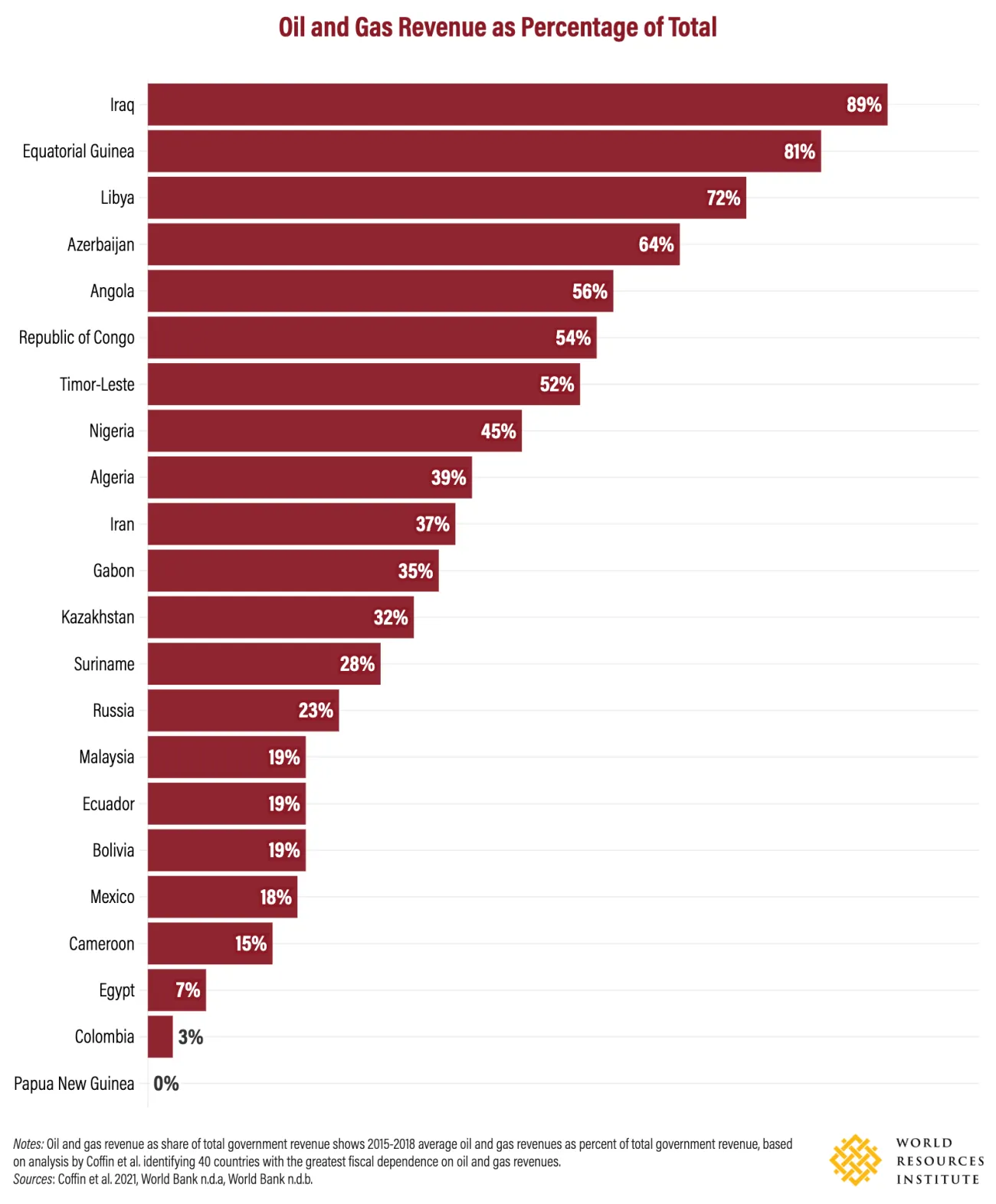
Devashree Saha et al., 26 January 2023, https://www.wri.org/insights/just-transition-developing-countries-shift-oil-gas
Fossil-rich countries tend to have authoritarian leadership, weak institutions, and a less diversified economy. Wealth tends to be captured disproportionately by elites, leading to high inequality. While it should not be the role of MDBs to finance autocratic elites who are currently making fortunes through the global fossil crisis, there are still several good arguments to engage with them on TAFF:
- The fiscal crisis following global oil and gas decline will impact them extremely severely, putting social and economic progress at risk and increasing the risk of political instability and turmoil.
- A fiscal crisis in a number of fossil-producing countries can potentially affect global supply chains as well as global financial and political stability.
- Helping these countries diversify offers opportunities to develop more inclusive economic activities and create local value.
- This will also enable more democratic political structures and help reduce social inequality.
However, the task is huge: transitioning away from fossil fuels in exporting countries not only means a substitution of fossil energy with clean energy – it means a restructuring of their entire economies. The aim should be to create sustainable economic structures that will enable a country to benefit from the global transition to net zero – rather than being destroyed by it – and to ensure long-term wealth rather than short-term fossil revenue.
What MDBs should offer these countries:
- Realistic macroeconomic stress-testing for declining fossil demand scenarios: Global demand for fossil fuels will inevitably drop, sooner or later. To act swiftly, countries need to know what to expect in terms of economic recession and inflation, budget deficits, stranded assets, debt pressure, job losses, and instability, and MDBs should offer their expertise to conduct respective analyses.
- Help in analysing a country’s potential for economic growth in climate compatible sectors and activities: This potential should be analysed taking into account production, employment, export and local sales, social benefits, and increases in social equality. Although economic opportunities may include the sourcing of critical minerals, it is essential to also consider other, non-extractivist sectors such as renewable energy production, manufacturing of technology for renewable energy and electric vehicles, green agricultural and green industrial products, as well as small and medium-sized enterprises’ (SMEs) potential in different domestic green activities (e.g. solar panel installation, clean cooking technology). The focus should be on activities that create local green value chains and benefit the local population.
- Support in anchoring green diversification nationally and regionally: MDBs can help countries in effectively integrating the identified diversification pathways in relevant national strategies, economic policy, and regulation. They can also support efforts for regional integration and the consideration of national diversification options in relevant regional strategies and fora (e.g. to build regional supply hubs for clean energy equipment and green agricultural goods). This also involves close cooperation with other development finance institutions, including alignment of country approaches and regional strategies. Coordination via country platforms could be very effective in this regard.
- Help in identifying financing mechanisms for diversification efforts: Fossil-producing countries should seek to redirect an increasing proportion of their revenue from fossil fuel exports to instruments (e.g. funds, budget lines) that support green diversification and the energy transition. In addition, they should create funding instruments that are independent from fossil fuel revenues (e.g. green bonds, carbon pricing systems).
- Promotion of technology transfer to the Global South: MDBs can engage with their shareholders from industrialised countries to emphasise the need for transferring relevant technology to developing country partners to enable progress on building local green value chains. This also carries benefits for Europe – after all, stability in these countries is also an international security question.
A lot of this can happen via smart technical cooperation and support for policy design, not necessarily involving large sums of new money. Importantly, these measures need to come with requirements to involve civil society and to take the needs and demands of the local population into account – then they can also strengthen democracy and human rights and contribute to political and economic stability.
Next steps
At Santa Marta or the follow-up conference hosted by Vanuatu and Ireland in the run-up to COP31, MDBs should commit to participating in and supporting the TAFF process. They should commit to supporting the TAFF agenda by assisting fossil-producing countries’ green diversification efforts. The next step could be an elaboration of a joint MDB strategy for green diversification – ideally linked to MDBs’ efforts to support the creation of country platforms. MDBs should also consider including a key performance indicator on reducing partner countries’ fossil dependency in their performance frameworks.
Furthermore, EU shareholders of MDBs should seek to support green diversification and technology transfer to developing partner countries as part of the new Global Gateway strategy, the Global Europe budget, as well as any potential future Clean Trade and Investment Partnership.