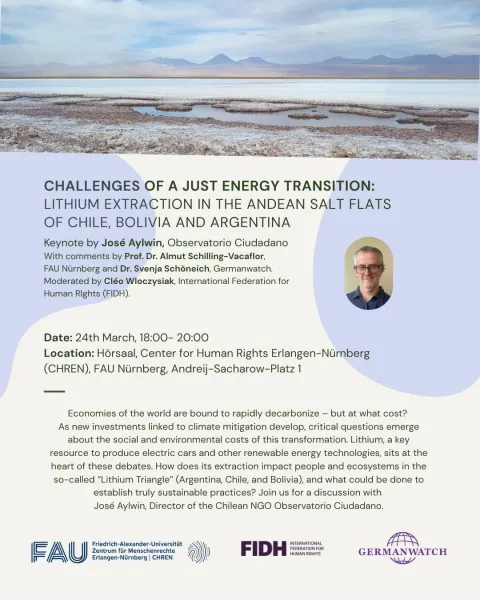
As economies decarbonize, the demand for critical ressources is reaching unprecedented levels. By some estimates, Lithium, crucial for EV-batteries, is projected to increase 40-fold by 2040. While the EU's narrative evolves around securing access to the "white gold" to ramp up the energy transition, we should be talking much more about what this transition actually entails for the extraction-impacted regions themselves.
The so called Lithium Triangle of Chile, Bolivia and Argentina provides much of the world's Lithium. While the region could profit immensely by this position, critical voices and unresolved conflicts shape the local reality just as much. How does Lithium extraction exactly impact the people and ecosystems in the region and what could be done to establish truly sustainable, equitable partnerships and local practices?
Together with a representative from Chilean Civil Society and leading experts from Academia from Nuremberg, we’ll discuss the challenges of a just energy transition, focusing on lithium extraction in the Andean salt flats of Chile, Bolivia, and Argentina. As global demand for lithium continues to rise, it’s crucial to also look at the social and environmental impacts in the regions where it is sourced.
Veranstaltungsort
Hörsaal, Center for Human Rights Erlangen-Nürnberg (CHREN)
Andreij-Sacharow-Platz 1
Nürnberg
Deutschland