Climate change is one of the biggest challenges of our time. We know that humans are responsible for global warming – now it is on us to act and mitigate the climate crisis.
The good news is that it is still possible for us to avert dangerous climate change. However, we must act very quickly and decisively to do so. Science, in particular the International Panel on Climate Change (IPCC), also known as the World Climate Council, provides guidance in this regard. Scientists from all over the world evaluate the latest research on climate change and summarise the most important findings in their reports.
Our planet’s atmosphere consists of various gases. This includes oxygen and nitrogen, but also greenhouse gases, of which carbon dioxide (CO2) is the best known. These greenhouse gases ensure that some of the energy that reaches the Earth from the sun remains in the atmosphere. This leads to the Earth’s surface warming up. We call this phenomenon the natural greenhouse effect. The greenhouse effect has an important function: it makes our planet habitable for humans, because without it the global average temperature would be around -18°C. However, greenhouse gases’ concentration has increased dramatically in recent decades. This is mainly because humanity has burnt huge amounts of coal, oil, and gas since the beginning of the Industrial Revolution around 250 years ago. In addition, other human activities, such as intensive land use and deforestation, have contributed significantly to the rapid increase in greenhouse gas concentration in recent decades. This, in turn, is changing the Earth’s radiation balance: solar radiation is increasingly remaining in the atmosphere in the form of heat, causing the global average temperature to rise – relatively quickly. The global average temperature has already increased by 1.1°C compared to pre-industrial levels. Scientists agree that humans are responsible for this rapid rise in temperatures and that the resulting climate change will have very dangerous impacts if we do not curb it as quickly as possible.
Focus on the 1.5°C limit
In 2018, the IPCC’s special report once again emphasised how important it is to limit global warming to 1.5°C. If this limit is exceeded, our livelihoods will be under serious threat.
During recent years, at least initial efforts to stay within the 1.5-degree limit have been taken:
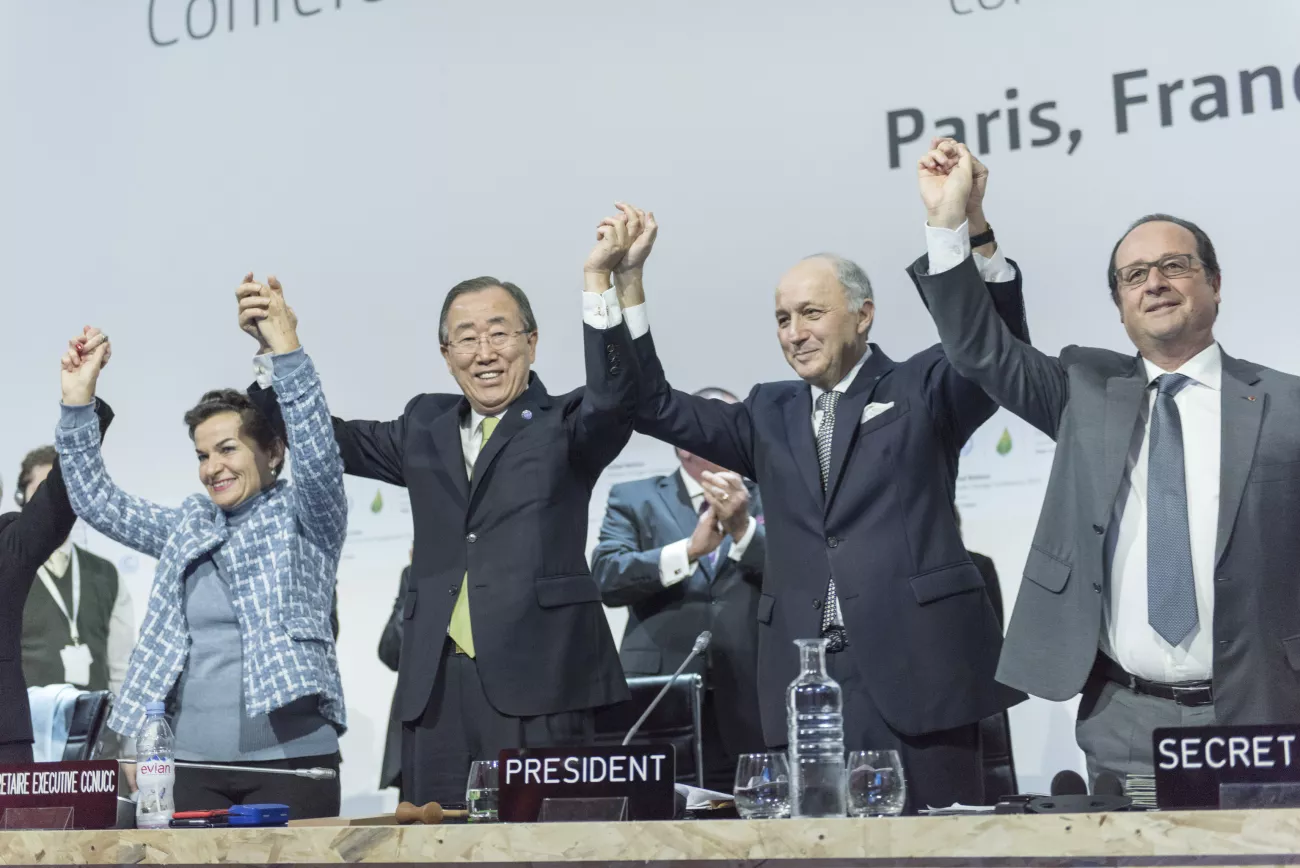
- At the international level, the Paris Climate Agreement of 2015 was an important milestone: in 2015, the international community agreed to limit global warming to well below 2°C, and, if possible, to 1.5°C compared to pre-industrial levels.
- By passing the EU Climate Law in 2021, the European Union committed itself to achieving climate-neutrality by 2050.
- Germany aims to achieve this goal by 2045, as stated in the Climate Protection Act, which was amended in 2021 following a lawsuit before the Federal Constitutional Court.
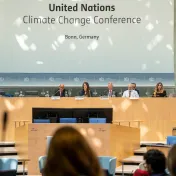
UN Photo/Mark Garten by flickr (CC BY-NC-ND 2.0)
Secretary-General Ban Ki-moon (second from left); Christiana Figueres (left), Executive Secretary of the United Nations Framework Convention on Climate Change (UNFCCC); Laurent Fabius (second from right), French Foreign Minister and President of the UN Climate Change Conference in Paris (COP21); and François Hollande (right), President of France, celebrate after the historic adoption of the Paris Climate Agreement in 2015.
‘Human-induced climate change is already affecting many weather and climate extremes in every region across the globe.’ This statement was made by the Intergovernmental Panel on Climate Change (IPCC), the central body on climate science, in one of its latest reports. In other words, people around the globe are already feeling the devastating impacts of the climate crisis today. This is also the case in Germany, where the probability of extreme weather events like droughts or floods has increased in recent years. For example, scientists have come to the conclusion that the climate crisis has increased the risk of flooding disasters, such as that seen in the Ahr Valley, by a factor of 1.2 to 9 in Western Europe. In addition to such extreme weather events, long-term impacts of climate change also threaten our livelihoods. An example is the slow rise in sea levels, which poses particular challenges for coastal areas. If the global average temperature continues to rise, critical thresholds, known as tipping points, could be exceeded. In the worst case, this would trigger a domino effect which would further exacerbate the consequences of the climate crisis. This makes it all the more important to push ahead with the necessary measures to mitigate climate change and limit global warming to 1.5°C. At the same time, however, we must also adapt to the consequences of climate change that cannot be averted, and support the countries and populations that are particularly affected in coping with the damage and losses.
Climate policy defines the framework
Based on scientific findings, international, European, and national policymakers set the targets to be achieved in the coming decades. However, implementation is stalling: if the current climate policy remains unchanged, we are heading for global warming of around 2.7°C. The task in the coming years will therefore be to actually meet the climate targets, and to improve them if they are not compatible with the 1.5-degree limit.
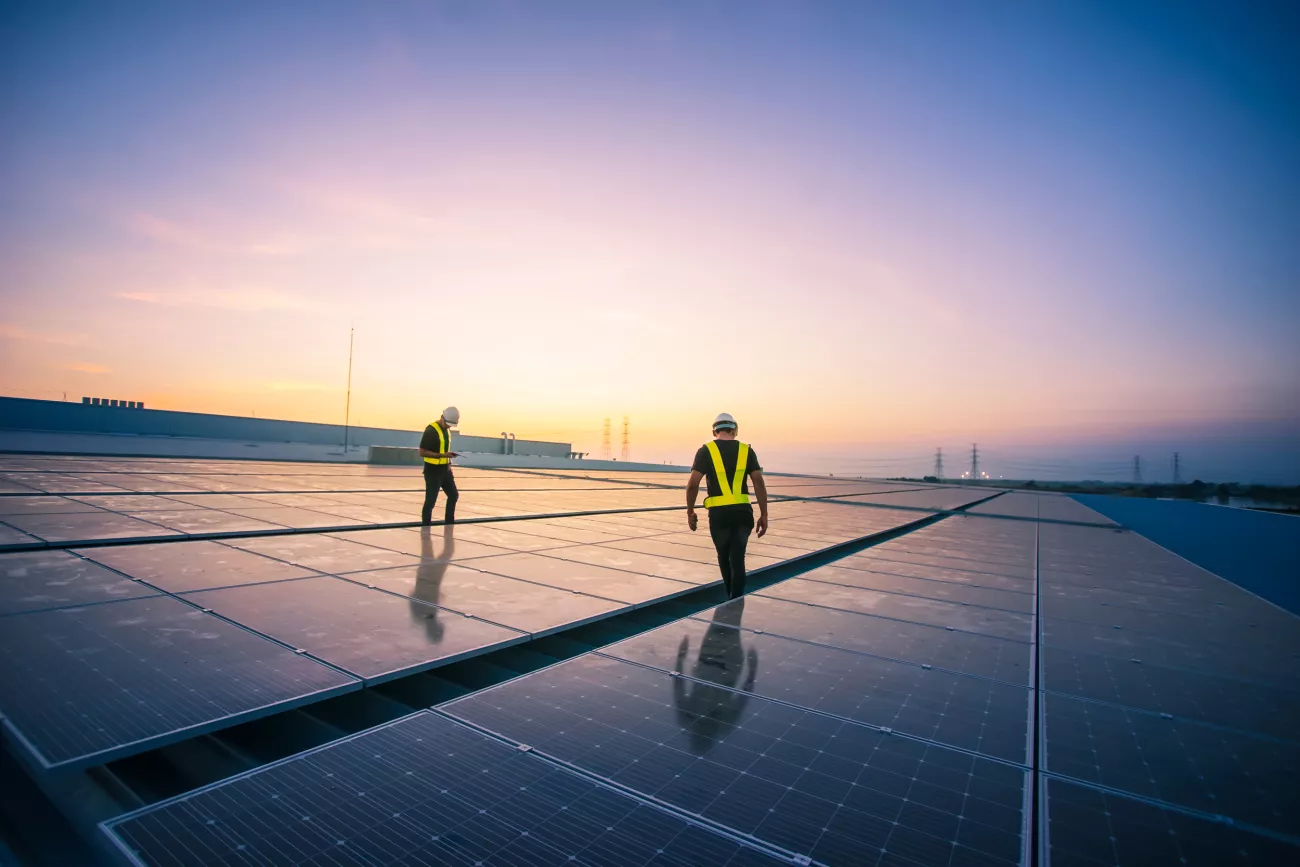
Foto: Shutterstock / ME Images
Workers installing solar panels on a roof.
One thing is for sure: the climate crisis presents us with a wide range of challenges that cannot be solved with a single measure. Instead, solutions must be developed and implemented in multiple areas. The following approaches are particularly important in this regard:
- Renewable sources of energy, such as wind power or solar energy, can substantially contribute to replacing fossil fuels and thus reducing CO2 emissions. The expansion of renewable energies has increased significantly in recent years, partly because the costs of these future technologies have fallen rapidly.
- The transition to climate-friendly means of transport is a crucial step toward limiting greenhouse gas emissions. Germany is lagging behind in this area. This is one of the reasons why Germanwatch has filed a constitutional complaint with the Federal Constitutional Court.
- We need an economy that no longer depends on fossil fuels – coal, oil, and gas. The technical possibilities exist in almost all areas. To give just one example: steel production currently consumes tons of coal, which is why it is one of the largest industrial CO2 emitters worldwide. However, it is now possible to drastically reduce greenhouse gas emissions, for example by replacing coal with hydrogen. Under the right conditions, this makes it possible to produce climate-neutral steel.
Justice in the climate crisis
The climate crisis does not stop at national borders. Climate policy therefore affects not only virtually all areas of our lives, but also everyone around the world. This is why it is particularly important that the necessary changes are implemented in a fair way.
On the one hand, this is a question of global justice. The countries of the Global South have contributed the least to the climate crisis. Consequently, the industrialised countries bear greater responsibility for combating climate change – this was agreed by the international community in the United Nations Framework Convention on Climate Change (UNFCCC), which was adopted in Rio de Janeiro in 1992. One of the key elements of this is international climate finance, which is intended to provide money for measures to mitigate climate change and for dealing with the impacts of climate change.
Those who have contributed least to the climate crisis are disproportionately affected by it. This is why climate policy is largely about justice – without justice, it will not create chances for fair and sustainable development for all. On the one hand, this applies at the global level: in the past, industrialised countries like Germany or the United States have emitted far more greenhouse gases than most countries in the Global South, and this imbalance still exists today. As early as 1992, the United Nations Framework Convention on Climate Change (UNFCCC) stated that industrialised countries bear greater (historical) responsibility for climate change and that the costs for climate change mitigation should be distributed fairly. This greater responsibility obliges the rich industrial countries to make greater efforts than other countries to rapidly reduce greenhouse gas emissions. On the other hand, the climate crisis often hits those population groups hardest who contribute least to it – such as small farmers, indigenous communities, and the elderly and sick. They too are included when we talk about climate justice. In general, it is important that individual countries act in accordance with their respective share of responsibility for the climate crisis and that the costs are distributed fairly.
A fair transformation should also be ensured in Germany and Europe. Extreme weather events, which are becoming increasingly likely due to the climate crisis, affect everybody – but they hit low-income groups particularly hard. In addition, the necessary political measures for climate protection, such as a high CO2 price, also place a greater initial burden on low-income households. Here, too, climate policy should aim to distribute the costs of the climate crisis fairly.
Climate policy at Germanwatch
When the first World Climate Conference (COP1) took place in Berlin, Germanwatch was there. Since then, we have acted as the voice of civil society at all climate conferences. This shows that climate policy has been a core concern of Germanwatch from the very beginning. This applies not only to international climate negotiations – we have also been working on climate policy issues at the national and European level for many years.
Our work focuses on the following areas:
International climate policy
- UN Climate Change Conferences: The UN Climate Change Conferences are of central importance to our work on international climate policy. We have been present at the World Climate Conferences from the very beginning to advocate for ambitious international climate policy. Every year, we also publish the Climate Change Performance Index (CCPI), which compares different countries’ climate change mitigation efforts.
- International climate cooperation: The climate crisis is a global challenge. Only if the international community works together, will it be possible to meet climate targets in time. This is also why Germanwatch works with partner organisations in India, Indonesia, China, Africa, Latin America, and the Western Balkans.
- Dealing with the consequences of climate change: Droughts, heat waves, or floods are just some of the catastrophic consequences of the climate crisis. Among other things, we are committed to ensuring that the costs of dealing with these consequences are distributed fairly.
Germanwatch
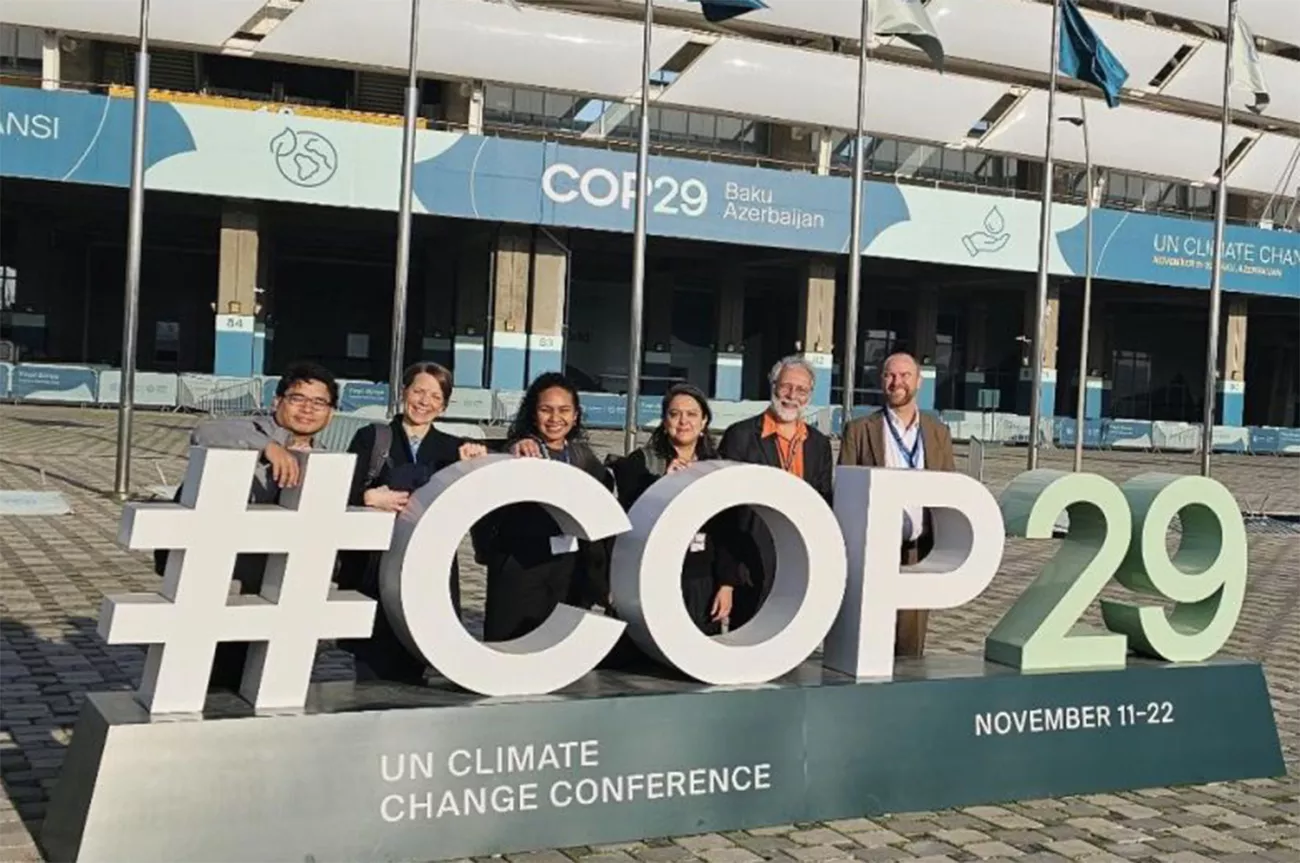
Germanwatch staff at the 2024 UN Climate Conference (COP29) in Baku.
Climate policy in Germany and the EU
- EU climate policy and CO2 prices: We are committed to a European climate policy which pursues ambitious climate targets and ensures that these targets are implemented fairly. Thus, carbon pricing flanked by appropriate social support can significantly advance the transition to a climate-neutral future.
- German climate policy and energy transition: The targets for German climate policy have largely been defined. The task now is to ensure that the transition to climate neutrality is socially equitable, particularly when it comes to heating and mobility. A successful climate policy depends to a large extent on the transition to an energy system based on renewable energies. To achieve this, we are focusing on important parameters such as grid expansion and a green hydrogen economy.
- Mobility transition: In the transportation sector, we want to help make climate-neutral mobility possible for everybody. In particular, we call for an expansion of the railway network and a reduction of the carbon footprint of air travel.
- Industry transformation: Our work on industry transformation aims to maintain and strengthen industrial value creation and good, collectively agreed working conditions in Germany, while at the same time paving the way towards greenhouse gas neutrality and a circular economy. At the international level, we are advocating socially just change as well. This means, for example, that local populations should always be involved when climate change mitigation measures are taken in their regions. Ideally they should benefit from these measures themselves. At the same time, it is important for industrialised countries to cooperate with countries in the Global South to advance the global energy transition, for example by forming ‘Just Energy Transition Partnerships’.
Financing the transition
- Climate finance: We advocate for additional international climate finance and its effective use. Every euro spent helps to avert future climate damage, thus saving many times the amount invested.
This overview shows that Germanwatch addresses many different climate policy issues and works with partner organisations around the world. The awareness that those who have contributed least to climate change suffer most from the impacts of the climate crisis is an important connecting element – and will continue to be a focal point of our work in the future.